Marketers who want to assess their products’ standing in the era of generative engine optimization can begin with a simple “Yes or No” question.
“Does AI recommend my product when a user says they’re looking for something just like it?”
Knowing the answer to this question is important, but it’s only the first step in understanding your product’s position in an e-commerce landscape where shoppers increasingly leverage AI-driven tools for research and discovery. Whether your product is recommended or not, your essential next steps are all about clarifying the “Why” and “How” behind that “Yes or No.”
Why is my product being recommended or filtered out today? How can we improve it from here?
Tried and true SEO thinking says that we should focus on consumers’ search methods to answer these questions and refine our strategy. But where traditional search is about keywords we can try to anticipate, AI-enabled search is about the highly personalized dynamics of any single user’s interaction with AI. The average shopper who turns to ChatGPT to find the right sunscreen, coffee, or dog food might use some of the same keywords they once plugged into Google for the same purpose. But an LLM’s ability to generate responses that reflect its contextual relationship with the user encourages us to enter ever more detailed queries and pose follow-up requests in a single conversation. The result is not just a ranked list of possible solutions. It’s a collection of the best possible solutions created with one person in mind.
When queries are this unique and responses are this specialized, there’s no predicting the one or bidding for placement in the other. What is possible, though, is understanding how LLMs conduct product research on behalf of a user. We know it might be tempting to imagine that your LLM of choice just quietly runs a quick Google search to dress up top results as its own sleuthing. The reality is more complicated. And it gets us to the “Why” and “How.”
LLMs construct responses to user queries by performing multiple rounds of hundreds of searches known as fan-out queries. These interrelated, minutely varied queries are meant to take the LLM on an exhaustive journey to any corner of the internet that might offer something relevant to your needs. During this behind-the-scenes process, the LLM develops, edits, and refines its final answer to your question before delivery.
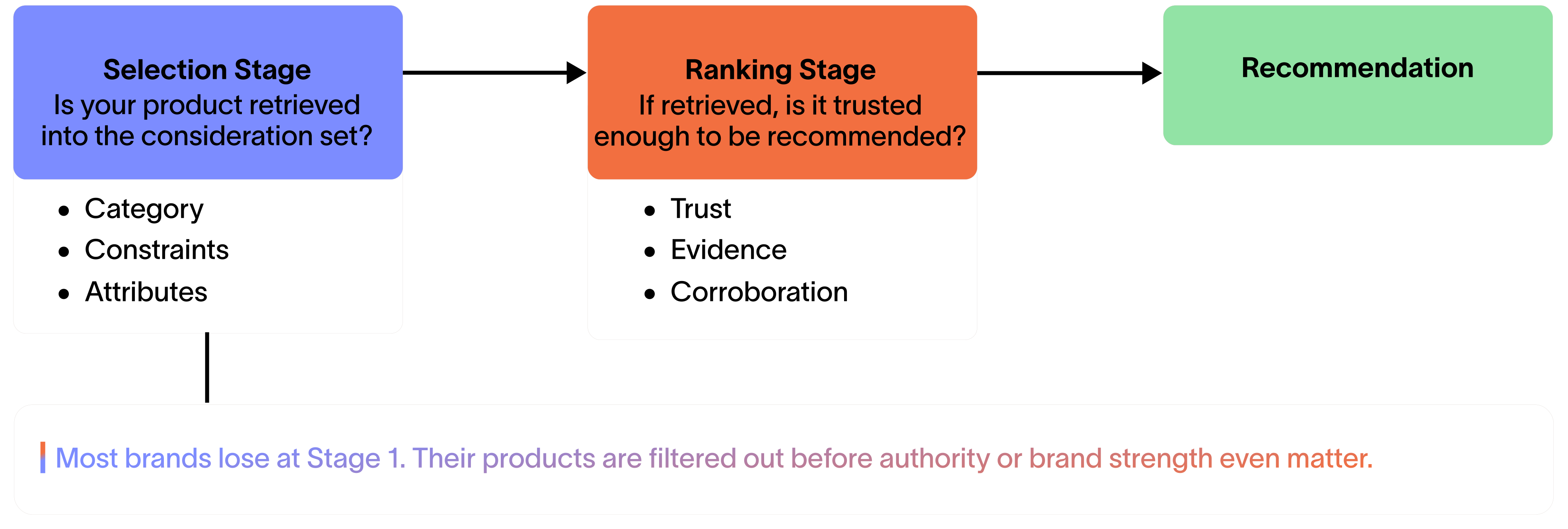
Let’s break this process down into a couple of concrete stages to illustrate how machine reasoning works in this context. Each piece of the process introduces a new type of filter that your product must clear in order to make the user-facing shortlist of recommendations, and your performance here is the answer to the “Why” your product is or isn’t being surfaced.
And remember, AI recommends products for purchase, not brands in shopping experiences. Brand awareness is much less relevant at these early stages of the recommendation process.
At this point, the AI engine is feeling out whether a product should be considered for surfacing at all. The Selection stage determines which products enter the initial consideration set. In practice, this is where most products are filtered out before ranking even begins.
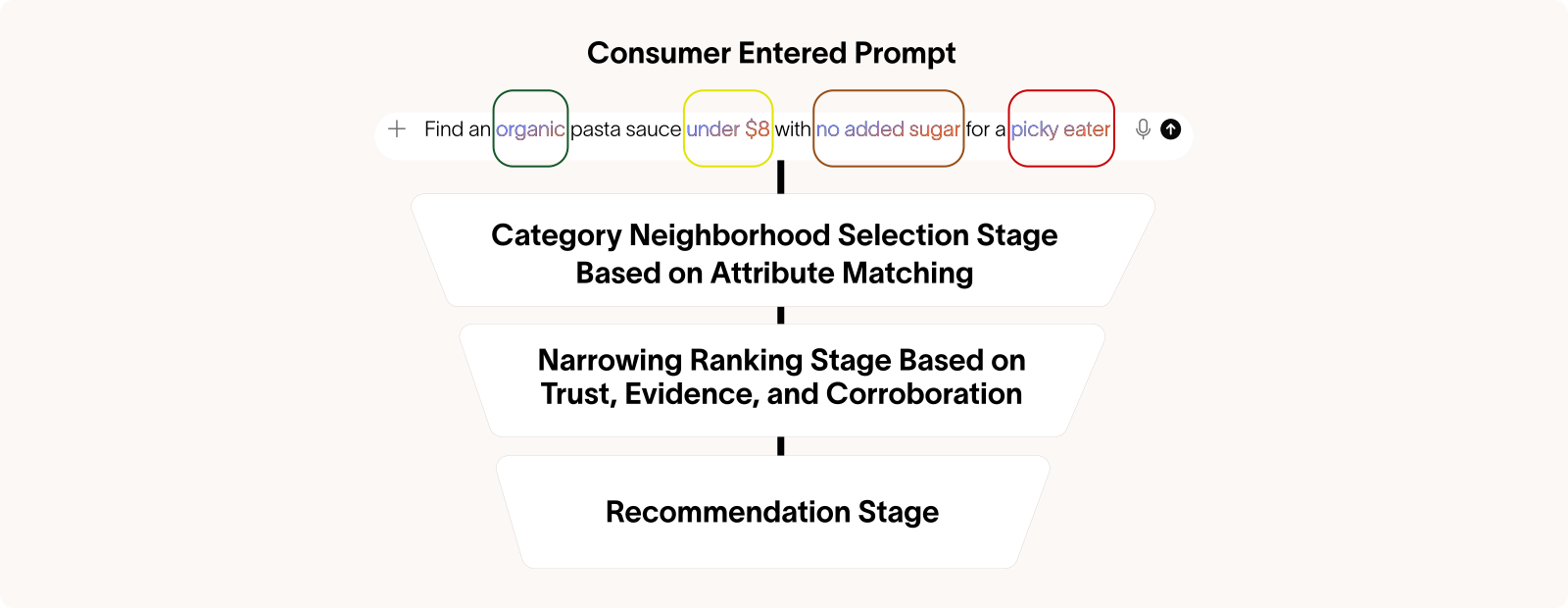
To help visualize the Selection stage, let’s imagine it as three filtration steps arranged into every marketer’s favorite shape: A funnel.
The LLM starts at the top of the funnel with a broad Category Neighborhood Selection filter. This portion is pretty straightforward. If your product is a sunscreen and the user asked about coffee, the model won’t find you in its hunt for answers, and you are effectively disqualified from consideration. If you are in the coffee business, you’re in the running! That’s one hurdle cleared.
The next level of filtration involves Context & Constraint Narrowing. This one is intuitive as well. Let’s say that our hypothetical coffee consumer has asked their AI agent for a selection of the best fair trade, light roast coffees of African origin that retail for no more than $30 per pound. That’s four boxes that your product has to check to stay on the radar.
If your product clears the bar set by the user’s constraints, it remains in consideration for another pass while the LLM conducts Attribute-Based Eligibility Matching. Whether or not your product remains in contention comes down to the degree to which it meets or exceeds the standards in the user’s query. In our example, the LLM could dig into the balance between the user’s request for “the best” coffee of a certain type and their desire to stick to a certain budget. A product that meets all of the constraints at a price of $25 per pound could be better-positioned here than a comparable product that’s still within the constraints at $28 per pound. At this stage, the context of a user’s conversation history on the AI platform has exceptional bearing, as whatever the LLM recognizes and recalls about the user’s interests and priorities can influence decision-making.
If your product’s attributes and value proposition represent a strong match for our coffee drinker’s research query, the LLM will group you into the Initial Consideration Set. Congratulations! But the work isn’t done yet. Your product is now in the running…to be in the running.
Advancing beyond the Selection stage is a matter of your product possessing the qualities that the shopper requested and communicating those qualities clearly. Now it’s time to really make your case. The Ranking stage is where authority begins to matter most. Here, the LLM re-evaluates its Initial Consideration Set to decide which of the contending products will make the shortlist it flags to the user. If Selection was like a job interview for your product, Ranking is where finalists are vetted before receiving an offer.
If you’ve browsed our content before, you’ve probably noticed us pushing the importance of having comprehensive data and credibility signals attached to all of your products, wherever they live on the internet. Maintaining this practice is the key to the “How” of getting shortlisted for shoppers using AI tools and bolstering your product’s eligibility for recommendation.
To pare the Initial Consideration Set down to the handful of products the shopper will see, the LLM scours the internet for trust signals to determine which select few products are reliable enough to surface. The trust signals we’ve flagged before are still the most meaningful:
In our coffee example, this means that a product in the Ranking stage will perform better with complete, uniform data attached to its corresponding listing in the online catalogue of any roaster, coffee shop, or other retail platform where it can be found. Attributes like fair trade certification should be listed along with the certifying organization. If reputable trade groups or contemporary coffee publications have praised the product, appending those notes will speak credibly to the user’s request for high quality options. The more you can communicate and prove your product’s bona fides in language that an LLM understands, the better your odds of being seen by someone ready to buy what you’re selling.
Why is your product recommended as often as it is? How do you level it up? To find satisfying answers to these questions, begin with a strategic approach to framing your products for maximum AI recognition. Novi’s solutions make us a trusted partner in laying the right foundation for any product to navigate the LLM recommendation filters between you and the shoppers who are ready to love what you have to offer.