Just a few weeks ago, we kicked off the new year with a review of why competing for top billing in AI search matters. Our breakdown led with a heads-up that the new advances in agentic commerce we saw making headlines in 2025 would probably pale in comparison to what 2026 could bring.
Well, we’ve been reading the news. And as of late-February, it’s not too soon to say that major advances have already been brought. We don’t mean to pat ourselves on the back; anyone observing the space in the last few months caught the same signals we did. But as these new developments accumulate, the most meaningful among them are worth calling out. We work hard not to miss a thing so that you won’t either. Because as agentic commerce speeds up, it’s getting ever more important to stay up to speed.
So here’s a recap of what’s new in the world of AI Shopping. Read on for coverage full of big names, big launches, and big expectations. Let’s dig in.
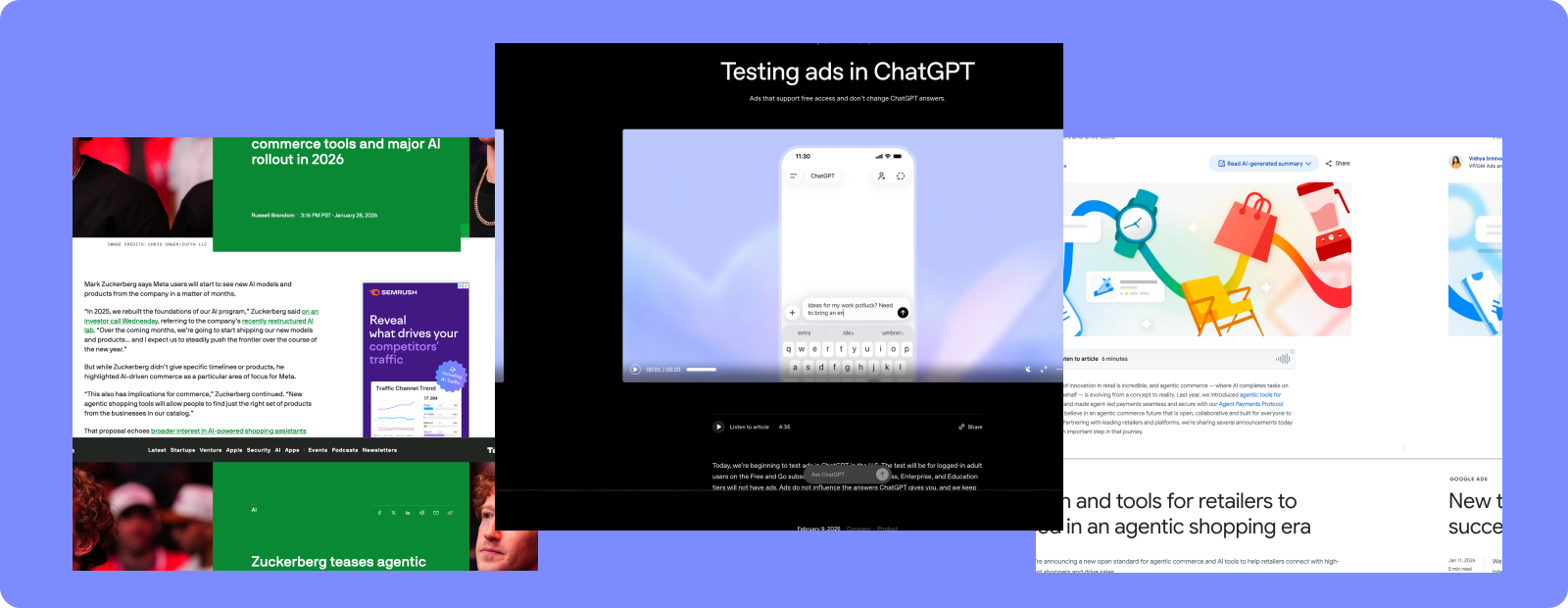
Everyone’s favorite search giant debuted their Universal Commerce Protocol in January. This new standard for operation on the Google platform was developed in concert with household names including Target, Walmart, Etsy, Shopify, and many of the biggest players in payment processing. It represents an answer to OpenAI’s Agentic Commerce Protocol, which launched back in October in partnership with Stripe.1
The UCP and accompanying Gemini Enterprise For Customer Experience suite of features are meant to enhance both sides of every potential transaction. If you’re a retailer, you’ll find resources that simplify product listing updates, improve customer service with intelligent problem-solving tools, and automate quality assurance guardrails built to monitor human employee performance.
Consumers in the Google ecosystem will now have the ability to calibrate an autonomous Gemini-powered personal shopper. Depending on the level of delegation, this AI sidekick will be capable of predicting a shopping list, filling a cart, and completing approved transactions. Those who prefer to stick to the Gemini chat format will note new features too, as a partnership with Walmart and Sam’s Club now facilitates the promotion and in-chat purchase of products from those retailers.2 No linking to a retail site, no product or specs of interest lost in the leap. It’s meant to be as simple as ordering dinner from your favorite pizza place via UberEats; no need to visit the restaurant’s webpage to check a menu or place your order.
To attract more marquee retailers to the new infrastructure, Google is already citing high profile success stories among their earliest partners. Companies like Gap and Home Depot are said to have realized improvements in everything from marketing to CRM, while Estee Lauder leveraged the new Gemini capabilities to build an AI Scent Advisor that can map online customers’ written descriptions to expert scent suggestions as a substitute for in-store guidance.3
Anything is possible, right?
While the chat-based features are an important part of this new launch, it’s clear that Google is still placing most of its focus on marrying AI functionality with its search format. By hewing to this familiar layout, the UCP launch clarifies a playing field with two distinct visions of what agentic commerce could be and what consumers might prefer.
Google is incorporating a slate of new features and capabilities into the search world it happens to dominate. On the other hand, OpenAI and its ACP emphasize the AI world’s dominant format, a chat-based sandbox where users interact with a conversational, personalized expert voice that uses general directives to steer toward specific destinations.4
If it was only a matter of time, the time is now. Sponsored content has entered the chat.
ChatGPT (Free or Go) users in the United States over the age of 18 will see advertisements starting to appear between their chat window and their text input field in the next week or so if they haven’t already.5
OpenAI seems to have anticipated a critical response to this development and were explicit in noting that they’ve prioritized “answer independence.” In practice, this should mean that the substance of a ChatGPT text response won’t be influenced by the ad shown alongside the chat. Impacted users will also have the option to reject individual ads or turn off the platform’s targeting abilities to avoid feeling monitored.6
The company remains nominally committed to its widely promoted feel-good mission to make AI an accessible tool for the betterment of humankind. And there’s certainly a case to be made that selling screen real estate to subsidize the cost of offering their most affordable service tiers helps to preserve democratic access. We’re staying tuned to see whether this smart business move comes with any reputational downside, but ads are as ubiquitous as the air we breathe, and it’s just as easy to imagine a future where we see them in higher-cost ChatGPT tiers, too.
Let’s add one more tech titan to the roll call. In late January, Mark Zuckerberg teased imminent moves in the agentic commerce space from Meta. The CEO emphasized the potential for targeted customization that Meta’s enormous trove of user data could unlock.
Zuckerberg told investors:
“I expect us to steadily push the frontier over the course of the new year. New agentic shopping tools will allow people to find just the right set of products from the businesses in our catalog. We’re starting to see the promise of AI that understands our personal context, including our history, our interests, our content and our relationships…we believe that Meta will be able to provide a uniquely personal experience.”7
Okay, perhaps this only qualifies as pre-news. But the reality is that one more platform that touches billions of users’ daily lives has expressed intent to flex its gravitational pull in agentic commerce. And that’s news in and of itself.
This batch of key reminders only scratches the surface of the last few weeks’ news in the world of AI-driven commerce. And we only know what’s been reported. Expect more. Given the level of investment and innovation behind making AI-driven discovery, comparison, planning, and purchase not just possible but popular, expect it soon.
And remember that Novi isn’t just your substitute for a Google News alert. We’re your answer to the question of how to get your products recommended by the most prominent AI discovery tools of the moment, in the sightlines of the most motivated consumers on the internet today.