AI-enabled search had a banner year in 2025 and will continue to establish its status as a go-to tool for consumers who were once content to start and finish their online product research with a legacy search platform. This shift will likely accelerate on the heels of a holiday shopping season that saw record AI use among consumers. The uptick led to a 693% year-over-year increase in AI-driven referrals to retail sites across categories, from electronics to personal care.1
The latest numbers are staggering. ChatGPT, the dominant player in the space, is now seeing over 5.5B monthly visits and fielding over 2B user queries every day.2 Other platforms like Claude and Google’s Gemini continue to grow their user bases while generating anywhere from 19M to 400M monthly visits. And while organic vs AI-powered search might not be a zero-sum game yet, the jump in AI use to date does correspond with an ongoing decline in the use of legacy platforms. The shift is significant enough that within the next three years, site referrals from AI tools are projected to eclipse those from organic search.3 With half of consumers overall now engaging with AI tools, half of all Google queries returning an AI-generated results summary on top of the usual stack of links, and $750B of revenue expected to flow into US companies via AI search by 2028,4 there’s no question which way the search ship is sailing. Time to get on board.
Whether you’re looking at a fresh start or a continuation when it comes to leveraging AEO on behalf of your products, there really is no time like the present. Because here’s one more thing we’re seeing: As search volume shifts from legacy engines to AI tools, the visibility of any given product is likely to take a tumble in the absence of a strategic approach that’s tailored to the current search landscape. So take action to put your products on LLM radars today. It’s the best way to keep them at the top of shoppers’ minds and generate tomorrow’s superior return on your AEO investment.
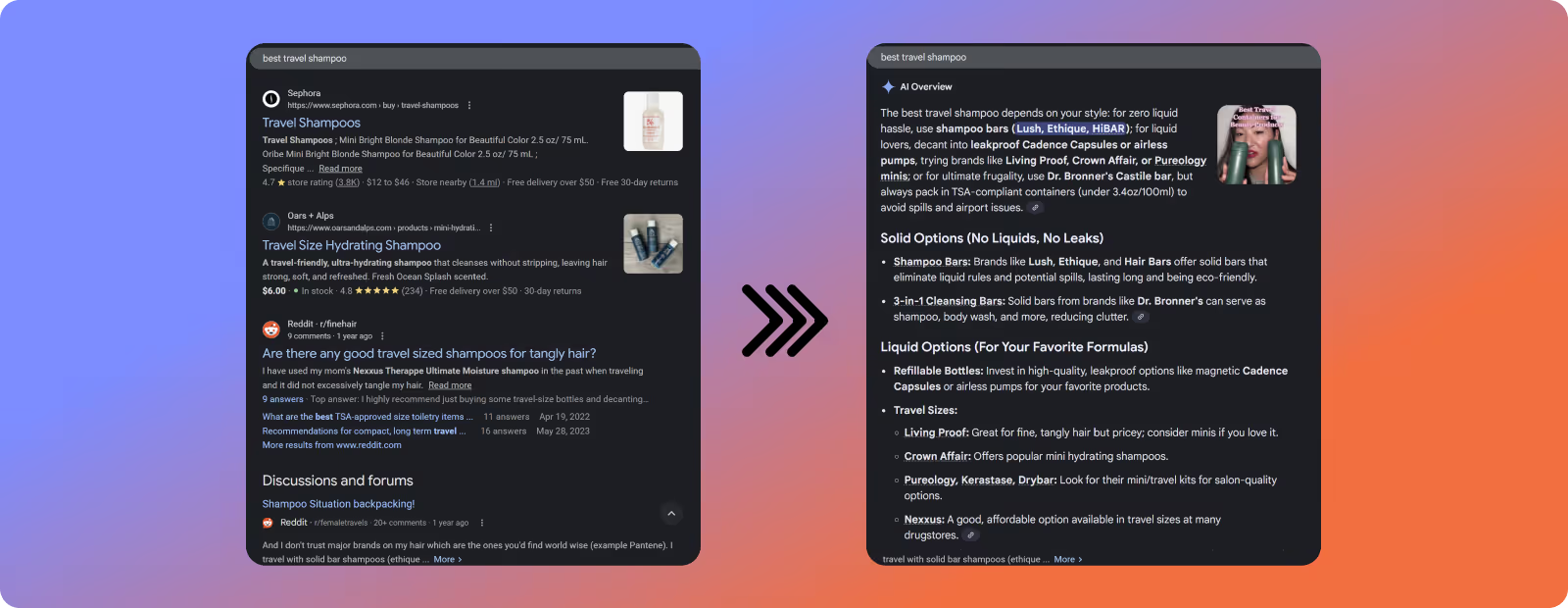
What’s behind this reasoning? It comes down to the way AI tools draft and deliver responses to user queries. Let’s say you’re researching the best travel shampoos using Google and ChatGPT; consider the different responses you’ll see.
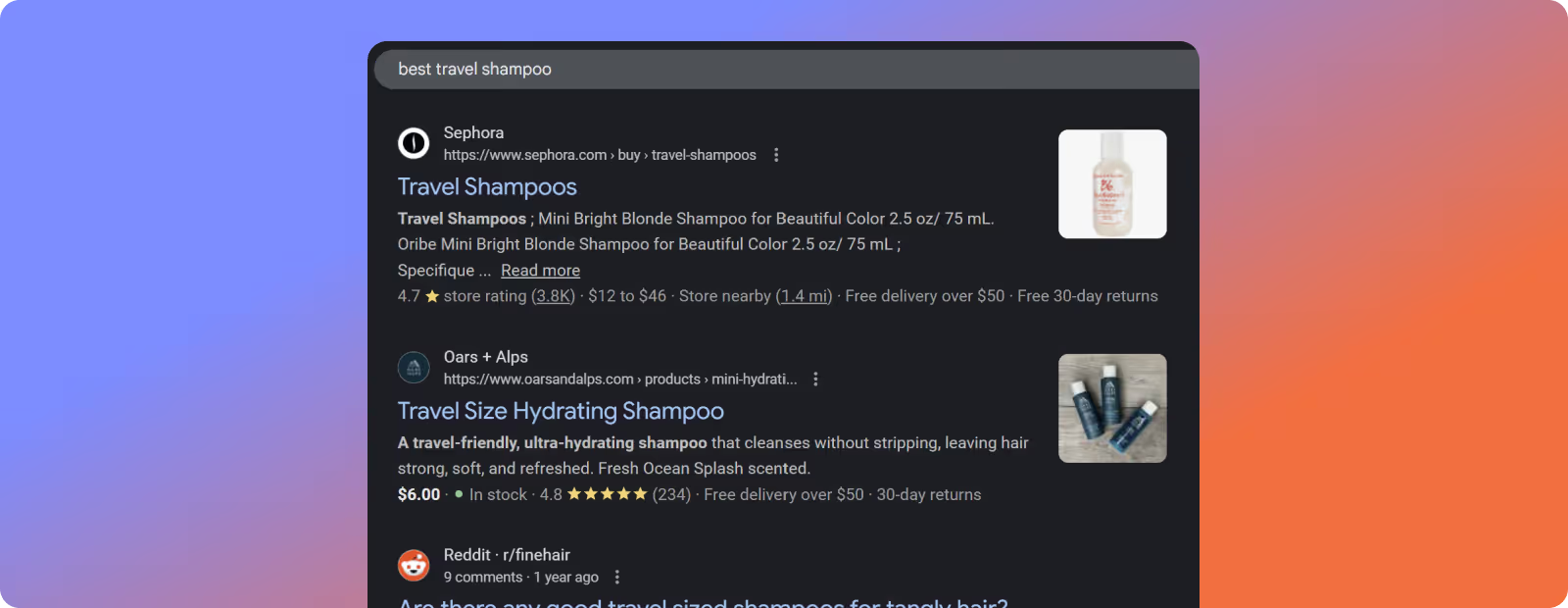
A classic Google search returns the familiar starting page with ten links connecting you to varying levels of shampoo expertise. Some are brand sites, others are listicles with ten ideas that may or may not overlap with your other linked results, and some are actual product thumbnails that probably won their position through paid promotion. At the bottom of that pile of links, you find pages and pages of other results. It’s a little bit of everything, and it’s a little overwhelming.
Today’s AI-enabled Google search looks a little different. In addition to the usual selection of links and thumbnails, you may also see a topline AI Overview (without even selecting AI mode!) that offers a paragraphed or bulleted distillation of relevant info and practical considerations.
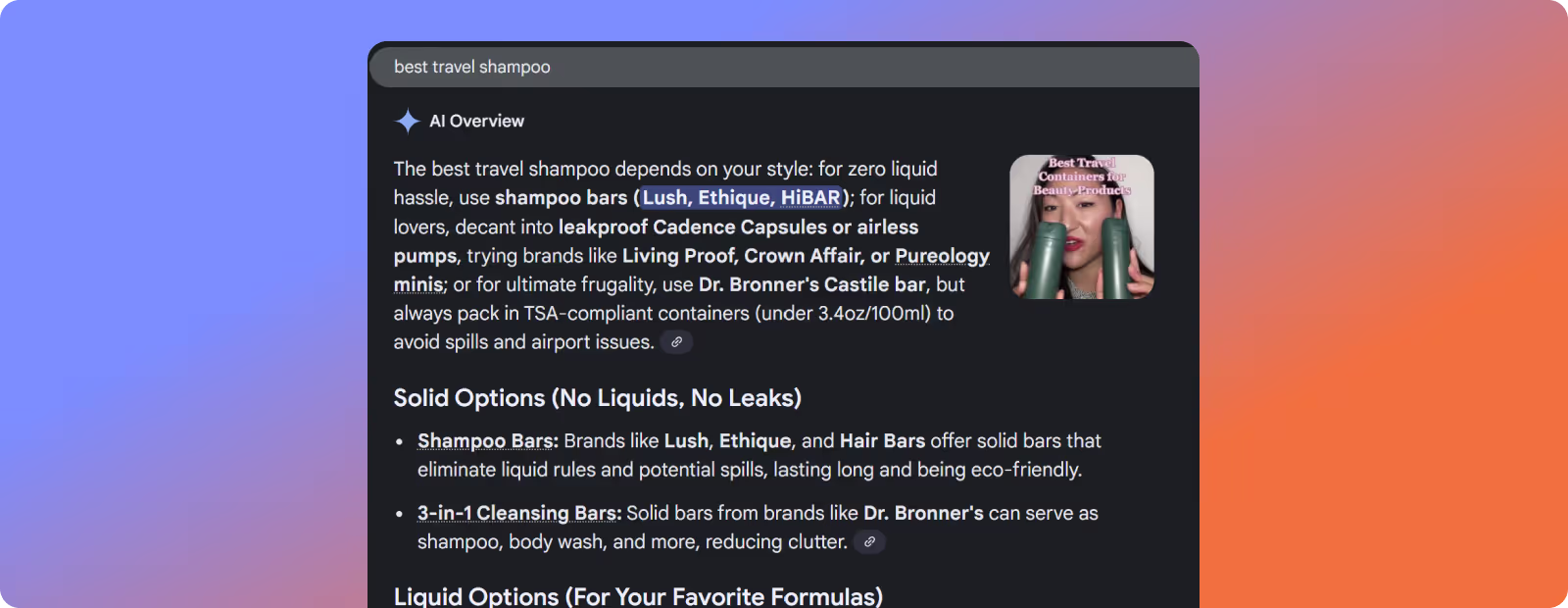
This overview, generated by Google’s Gemini LLM, is a fair approximation of what you’ll get by entering an equivalent travel shampoo query into ChatGPT. When researching with any of the best-known chat platforms, you’re no longer sifting through ten links that could send your product research down twenty new wormholes. What you get instead is just that handful of highly targeted recommendations selected because the LLM believes they’ll actually meet your needs. And if they don’t, the conversational nature of the response and the engine’s tendency to automatically offer follow-up questions or actions make it feel natural to refine your ask in the chat window.
The bottom line here is that in the future of search, consumers see fewer results, perhaps half of what legacy search offers at first glance. You and your brand are still competing with all the same players, but there are far fewer slots for designated winners in the AI arena.
It’s becoming more and more clear that being one of these designated winners carries even more value than winning at SEO does. Let’s break down a couple of the factors that make it so important to come out ahead in AI search.
First and foremost is the element of user intent. We know that LLMs go beyond keywords and incorporate a user’s explicit and implicit interests and preferences when responding to any given query. So if your brand’s travel-size shampoo appears in ChatGPT’s response to a question about that category’s best offerings, it carries more weight than showing up in the relative catch-all of a legacy search result for a comparable query.
That weight matters because AI is already beating legacy search when it comes to conversion rates, with some studies putting the conversion rate for ChatGPT referrals at 11.4%. That’s more than double the rate posted by legacy search.5
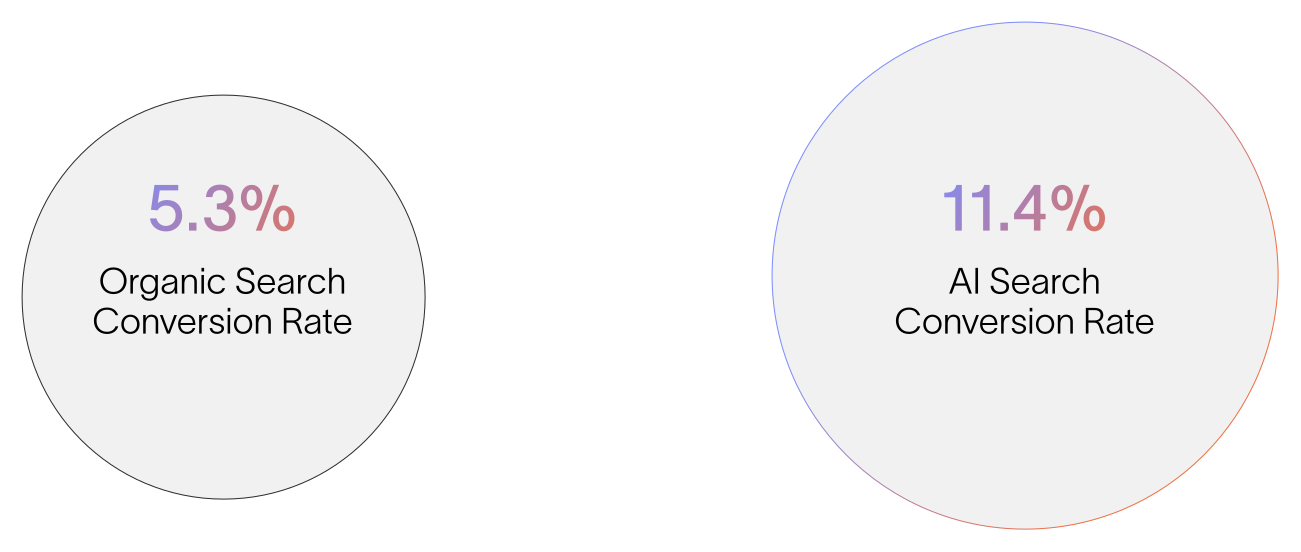
It all suggests that the consumers who are leveraging AI for product research are motivated buyers, or perhaps even that they become motivated in light of the more actionable intel they get from an AI response. They know that they can cast a broad net via their LLM of choice without having to click into dozens of results that don’t actually meet their needs. They seek personalized recommendations and, armed with higher-quality research, they feel ready to make a purchase.
We said above that it’s not too soon to shift focus to prioritize AEO in the new year, that there’s no time like the present. These aren’t simply generalizations. On the contrary, it’s important to recognize that the longer a brand puts off implementing strategies to increase its products’ visibility in AI search results, the harder it will be to see a satisfying return on the time and money spent.
One quality that humans and LLMs have in common is that we are, figuratively or literally, programmed to repeat behaviors that get positive reinforcement. If the joke you tell at a dinner party gets a big laugh, you’re more likely to recite it to someone else the next day. AI tools are trained to operate under similar incentives through reinforcement learning. It’s a practice that involves aggregating human feedback on chat responses in order to construct a reward model that helps the LLM assess its own performance. Once the LLM understands the parameters of good and bad when it comes to query responses, it can learn to double down on the right elements of grammar, ethics, factuality, or tone.6
“…The search result is now the answer itself. If a brand isn’t mentioned or cited in that instant, it effectively doesn’t exist.”7
-Kaare Wesnaes, Head of Innovation, Ogilvy North America
What does it all mean from a brand perspective? Simply put: When AI recommends products to users and many users respond positively, it conditions the underlying model to make those same recommendations again and again for related queries. Every question put to ChatGPT about the best travel shampoo is one more opportunity for ChatGPT to highlight the five products it’s been taught are reliable winners. Simultaneously, it’s one more opportunity for those products to reassert their superiority within the logic of the model. The cycle repeats, and the winners’ circle closes.
If established winners have the best odds of continuing to rack up wins in the future of internet search, getting positioned for success today is an imperative. That’s where Novi comes in. In the spirit of reinforcement learning, here’s a quick refresher on some of the proven winning strategies that we recommend for brands who are ready to maximize the returns on their AEO investment.
- Build credibility with AI platforms by emphasizing your products’ third-party certifications. These verified endorsements are more likely to raise your visibility than promotional language.
- Write PDPs for people; build your schema and feeds for machines. Make sure that the volume and content of your product data in these locations is calibrated to attract your human audience of shoppers and your new machine audience of AI-driven shopping assistants. This will be especially important as features like ChatGPT’s Instant Checkout evolve, moving us closer to a state of true agentic commerce where users can empower AI tools to make purchases and manage their shopping list.
- Structure your data and share it widely. Take a unified, conversational approach to product pages, reviews, FAQs, and more. LLMs aim to provide responses with context, and this will help them deliver it. Once your data is in great shape, make sure it lives everywhere your products can be found - retailer sites, shopping platforms, whatever the case may be.
- Understand your performance in AI search. Track your mentions and citations, and keep an eye out for newly emerging indicators of success in the market.
Being a first mover in a new space can be scary. But the AI search race is already being run. In 2025, it accelerated. In 2026, scores of brands will push past the starting line by implementing AEO strategies. Whether you’re starting from square one or re-evaluating at square five, our goal is to make the process both manageable and valuable. The sooner the better! We’re ready when you are.
1. Adobe: Holiday Shopping Season Drove a Record $257.8 Billion Online with Consumers Embracing Generative AI Tools. Adobe Newsroom, 7 Jan. 2026, Link.
2. Singh, Shubham. ChatGPT Users Statistics (January 2026) – Growth & Usage Data. DemandSage, 20 Nov. 2025, Link.
3. Handley, Rachel. We Studied the Impact of AI Search on SEO Traffic: What We Learned. Semrush Blog, 13 May 2025, Link.
4. Silliman, Elizabeth, Julien Boudet, Kelsey Robinson, Desirae Oppong, and Nilay Shah. New Front Door to the Internet: Winning in the Age of AI Search. McKinsey & Company, 16 Oct. 2025, Link.
5. Similarweb’s 3rd Annual Global Ecommerce Report: Growth Shifts to Apps and AI. Similarweb Ltd., 15 Sept. 2025, Link.
6. Curuksu, Jeremy. Fine-Tune Large Language Models with Reinforcement Learning from Human or AI Feedback. AWS Machine Learning Blog, 4 Apr. 2025, Link.
7. Liederman, Emmy. How Experts Say GEO, AI Will Change Discovery in 2026.eMarketer, 7 Jan. 2026, Link.